
John Daly, one of the world’s leading communication experts, is the Liddell Centennial Professor of Communication, TCB Professor of Management and University Distinguished Teaching Professor at the University of Texas, Austin.
In Part 1 of the interview, we discussed why there’s a need for a book on becoming a better advocate for one’s ideas. In Part 2, we discussed the skills necessary for effective advocacy. In Part 3, below, John talks about some of the counter-intuitive notions underlying successful advocacy.
Strategic Leadership Communication:
One of the distinguishing features of your book is that everything you recommend is rooted in specific, footnoted empirical research – beautifully integrated into the text, by the way.
John Daley:
Thank you.
Strategic Leadership Communication:
So it’s all valid and verifiable. And yet, so many of your suggestions seem contrary to people’s social intuitions.
John Daley:
It’s true. Many of our common sense notions and strategies for successful advocacy turn out to be misleading at best, and sometimes simply wrong.
Strategic Leadership Communication:
For example?
John Daley:
Networking, for one. You’ve all heard the phrase, “It’s who you know that matters.” In reality, that’s irrelevant. It’s who knows you that matters. The goal of networking is not to meet a lot of people; it’s to get people to remember you. A lot of people make that mistake. They go to a lot of “meets and greets,” and they forget the goal is to get people to remember you.
Strategic Leadership Communication:
I may be one of them. It’s certainly a widely-shared impression that networking is a quantity game, isn’t it? The more people you round up, the more likely you are to garner support from someone?
John Daley:
You don’t want to go after people; you want them to come to you. If somebody is looking for top-notch expertise, do you come to mind before anyone else? That’s what real networking is. You may have met me 15 times, but if I don’t remember you, it doesn’t matter.
Strategic Leadership Communication:
The point then, if I hear you right, is to network in order to generate what marketers would call, “top-of-mind awareness.”
John Daley:
Exactly.
Strategic Leadership Communication:
So quantity doesn’t matter; it’s all about the quality of the social interactions?
John Daley:
Quantity does matter. But the key point is that you’ll be successful, not when you want to be successful, but when other people want you to be successful. Getting them there is the goal of networking.
Strategic Leadership Communication:
Got it. Another area where our intuitive notions may work against our advocating successfully?
John Daley:
Favors. Reciprocity.
Strategic Leadership Communication:
Reciprocity? You scratch my back; I’ll scratch yours? That’s a bedrock principle of social influence; what’s counter-intuitive about that?
John Daley:
The bedrock is a bit shaky, I’m afraid. Let’s take a simple example. If I do you a giant favor, who owes whom?
Strategic Leadership Communication:
I owe you.
John Daley:
Not necessarily. More likely, I owe you. In fact, I may owe you even more if the favor is large enough.
Strategic Leadership Communication:
Wait a minute. You’re saying that if you do me a big favor, instead of me owing you, you owe me even more? That doesn’t make sense…. Which, of course is why it’s counter-intuitive, I guess.
John Daley:
It’s true that every time I do you a favor, you may indeed feel a sense of obligation. But look at it from my point of view: I’m investing in you and your success. And if I keep on doing that, in large and small increments over time, at some point, I’ve put so much work into making you successful, I’m not going to allow you to fail. Because at that point, if you fail, I do, too – it reflects back on me.
It’s like when you’re first starting your career, when some higher ranking, more experienced colleague adopted you – helped you out once, got you onto a project, or new assignment, made sure you didn’t get in trouble. By the time you’ve been there for a few years, this mentor is opening up career opportunities for you to jobs you didn’t even know existed.
Strategic Leadership Communication:
So, as someone who wants to advocate, the behavioral implication is…?
John Daley:
Ask people for favors. When people do you a favor, they’re actually investing in you. So, for example, when you have a question, ask for someone’s advice instead.
Strategic Leadership Communication:
I’m not sure how that follows.
John Daley:
When you have a question, and it has either a right or wrong answer, it feels interrogatory. If instead, you say, “I need your advice; I’m turning you into my personal consultant,” it makes them more committed to you in some ways.
Strategic Leadership Communication:
So, ask not what I can do for you; ask what you can do for me – because the more you do, the more you’ll feel obligated to do.
John Daley:
That’s the reality of how it works.
Strategic Leadership Communication:
We’ve talked a lot about engaging others to invest in you; what about something that you as an advocate can do yourself to increase your chances of success, but that may be at least a bit counter-intuitive?
John Daley:
One of my favorites in the book is this: you don’t want to sell solutions, you want to sell problems.
Strategic Leadership Communication:
I thought the idea was to solve problems, not sell them?
John Daley:
Selling problems is actually how you sell solutions. Really smart advocates don’t say, “I want to do x.” They create in the decision maker’s mind a problem, and then they hope the decision maker comes up with a solution close to what they have in mind. This is what the greatest companies in the world do as well: they don’t sell solutions, they create problems you’ve never had before.
Strategic Leadership Communication:
For example?
John Daley:
For example, booksellers in the 1920s wanted to increase sales. What did they do? They convinced homebuilders to create built-in bookshelves in people’s homes. And once you have built-in bookcases, you have a problem: you have to fill them up. So book sales increased. Grocery sales skyrocketed in the 1930s because a man in Oklahoma created the grocery cart. Once you have a grocery cart, what do you have a need to do? Fill it up!
Strategic Leadership Communication:
What happens when the problem is solved, or someone comes up with a competing solution?
John Daley:
You’d be surprised at the ingenuity that’s possible when you start manufacturing problems instead of solutions. Take Arm & Hammer baking soda, for instance. It was used for baking for 100 years. In the 1990s, however, with more people working outside the home, fewer and fewer had the time to bake. And so fewer and fewer needed baking soda.
So, Arm & Hammer created a new problem: odor in your refrigerator. People my age don’t remember a “refrigerator odor”. It was just the smell of the refrigerator. It wasn’t any big deal. Until Arm & Hammer created the “refrigerator smell.” Boom! Sales go back up.
And then, around 2000, the plot thickens when the refrigerator manufacturers started making refrigerators that had a nice scent. So, Arm & Hammer, endlessly inventive, created a new problem that we didn’t know we had before: odor in the garbage disposal. This is an extraordinary business concept when you think about it: You take your hard-earned cash and go to the store and almost literally pour that money down the drain! You never knew you had a problem with your drain before.
Strategic Leadership Communication:
Built-in bookcases, grocery carts, baking soda: they’ve all been around for decades and decades. Do you have a more recent example?
John Daley:
Absolutely. Probably the most recent example is in Europe. You probably have 15 cell phone chargers at home, right? Okay, at least more than one – one for every phone. After all, for every phone – Apple, Samsung, Nokia, HTC – you have a separate, incompatible charger. Why does every phone have a separate charger? Huge markup. Huge money-maker.
Well, starting this year in Europe, every phone will use the same identical charger. You know how they sold it? It wasn’t convenience. It wasn’t money. The problem statement was… the environment. Why the environment? Well, ensuring the quality of the environment is a deeply held value in Europe. And, guess what? Every one of those chargers goes in the ground at some point and leaches weird chemicals for something like the next 50 years.
The advocates for the universal charger were not successful until they found the right problem. Once they found the right problem, the answer was obvious.
Strategic Leadership Communication:
Thinking problems first, not solutions, does seem to go against the grain.
John Daley:
The point is that we’ve all been taught to sell solutions. But what I want you to do as an advocate is to create a problem in someone’s mind they didn’t know they had before.
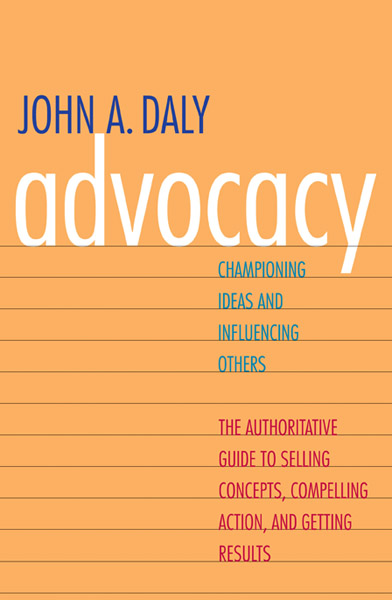
That ends part three of the interview with John Daly, author of (Advocacy). In the fourth and final part, Daly reviews some of the key mistakes advocates make and key barriers they face, and talks about what they need to do to overcome them.


 Strategic Leadership Communication