
A friend and former colleague of mine is the Senior Vice President, Human Resources, at a biotechnology products and services company – that is, one of those companies racing to create gene sequencing machines that can bring the price of having one’s genes sequenced under $1,000. Even more: working to make gene sequencing so inexpensive that in the not-too-distant future it will be a routine medical test, like a blood test, opening the way to the promise of personalized medicine.
My friend is about as good as it gets in HR. He’s got a Ph.D. in Organizational and Industrial Psychology, a stellar work ethic, a strategic mindset, a consistent history of producing results everywhere he’s been, and, as hard driving as he is, an ability to generate loyalty and high performance from those who work for him. In other words, when it comes to senior HR officials, he’s a rare bird, indeed. Among the best of the best.
Not surprisingly, word has gotten around about him among headhunters, and he’s constantly getting calls dangling in front of him from the top HR position at much bigger, better known, and seemingly more prestigious companies. And with higher salaries and more stock options. But he has only one word for them: “No.”
Why not? “Because this company’s technology is going to save thousands and thousands of lives, and change the quality of life for millions and millions of people. Because I am part of changing the world for the better, and more money or stock options won’t make another company more meaningful than that.”
***
Teresa Amabile is the Edsel Bryant Ford Professor of Business Administration and a Director of Research at Harvard Business School. She has spent upwards of thirty years studying what she calls “the psychology of everyday work life,” [1] as well as what makes workers creative and innovative, and what motivates them to higher levels of performance.
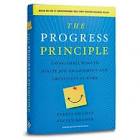
She’s recently been publishing and publicizing[2] the results of a multi-year research study on creative work inside businesses. As a result of “an exhaustive analysis of the diaries kept by knowledge workers,” she discovered something she calls the “progress principle.” As Amabile describes it, the progress principle is that “Of all the things that can boost emotions, motivation, and perceptions during a workday, the single most important is making progress in meaningful work.”[3]
The focus on “progress“ in the “progress principle“ is obviously central. But it is only one half of the equation. The other half: the necessary meaningfulness of the work on which progress is being made. Or as Amabile puts it, “Making headway boosts your inner work life, but only if the work matters to you.”[4]
***
What my friend and Professor Amabile have in common is their understanding of the power of work that is meaningful. When workers believe that the work they are doing matters, they’re more committed, productive, innovative, and high-performing. And their businesses are more profitable.
Which raises the question relevant to this blog: what accountability do senior leaders have for the “meaning” given to their work by their employees? Some leaders might suggest that the answer is “none!” After all, isn’t it the case that meaning is in the eye of the beholder? That what is meaningful work to you might have no meaning for me? So how can this be the responsibility of a senior leader?
Amabile believes senior leaders can impact meaning at work. Generalizing from her research sample of senior leaders, however, she seems to think that they are as likely to destroy meaning for their employees as they are to support it – so much so that she titled a recent article, “How leaders kill meaning at work.”[5]
But that hasn’t been our experience. What leaders can do, and in my opinion, should do, is to create a context or framework within which workers can connect to meaning. What does that mean? Here are three ways that senior leaders can enhance the meaningfulness of employees’ perceptions of their work:
1. Create an emotionally resonant context for work. Let’s start with a generic example. Think of the least meaningful work you can imagine. How about something like digging ditches, or shoveling sand, the kind of unskilled manual labor that seems more appropriate to prison labor gangs than to anyone else. Hours of backbreaking labor. How high is this likely to rank on the meaningfulness scale? Pretty low.
But now add an emotionally resonant context to the work: the sand and dirt being shoveled and dug up is being taken to river banks where it will be used in sandbags designed to prevent the imminent flooding of a major metropolitan area. Without this work, lives may be lost and millions and millions in damage will disrupt the lives of the city’s innocent residents. Meaningful work? Might you be inspired to work a little longer and a little harder?

The point is not that digging ditches is inherently meaningful, or that leaders should make up stories or exaggerate the uses of their employees’ work. Rather, it is that meaning is not an inherent quality of the labor itself, but resides in our understanding of it. Change the emotional context, and the same work takes on a different, richer, more powerful meaning.
2. Provide a broader framework for understanding the work. One would think that working in one of the restaurants of a national pizza chain would be a hard place in which to find meaningful work. After all, when high paying professional jobs are about to be outsourced overseas, fast food jobs are often held up as the essence of the meaningless work that will remain.
Maybe so. Those jobs will certainly not reach the pay scale of technical or professional labor. But that doesn’t necessarily make them meaningless. In fact, I’ve seen them framed in an entirely different way.
Another friend and former colleague is now president of a national restaurant chain and a member of the Board of Directors of one world’s most renowned entertainment brands. For him, working in the restaurant business isn’t meaningless at all, and never has been, even when he started as “low-paid labor.”
For him, food is the “stuff of life” (and to everyone else, for that matter), and serving it a noble cause. And pizza, in particular, played a very special role. “You’re not in the fast food business,” he would consistently tell employees at the national pizza chain where we both worked, “but in the business of bringing families and friends together, of creating opportunities for people to share with each other, and in doing so raising the quality of people’s lives.”

Overstated? Not to him. And while it’s true this framework for making and delivering pizzas didn’t send tens of thousands of his employees into rapturous delight, it did provide them with a broader, richer framework for what most of them thought of as mundane work. And it made it easier for them to understand the “why” behind strategic initiatives to improve product quality and customer service. They did, and both improved.
3. Invoke a powerful legacy. Two words: Steve Jobs. Many, including me[6], have questioned whether Jobs’ abysmal treatment of employees was necessary for his success. The better question may be why so many employees stayed with him despite his subjecting them to ongoing verbal abuse and constant humiliation? The obvious answer is that it was a cost they were willing to pay to be part of creating something that they believed could change the world, something bigger than themselves.

That this was something Jobs understood very well and may have used manipulatively is beside the point (most famously in recruiting John Sculley from PepsiCo, when Jobs asked Sculley whether he wanted to spend the rest of his life selling “sugar water” or “come with me and change the world.”) A better measure of the impact of invoking a powerful legacy is the number of employees who look back on their efforts with pride, despite the difficulties of working with a very difficult boss.[7] Or more: sign up with that boss again for another potentially “world-changing” product.
The bottom line: Leaders can provide a framework that makes it easier for employees to perceive their work as meaningful. But too few of them do. To do so, they must first see it as part of their job. And second, they have to master the basics of strategic leadership communication: the elements of which have been the essence of this blog.
[1] Amabile’s Harvard faculty bio can be found here.
[2] Published in the book, The Progress Principle: Using Small Wins to Ignite Joy, Engagement, and Creativity at Work. See also her Harvard Business Review article, “The Power of Small Wins.”
[3] See “The Power of Small Wins,” p.72
[5] “How leaders kill meaning at work,” McKinsey Quarterly, January 2012
[7] This comes across strongly in Walter Isaacson’s excellent biography, Steve Jobs.


 Strategic Leadership Communication
Excellent. I’ve been thinking about this too! My blog article, “Six-part harmony” aligns nicely with your three suggestions and the Steve Jobs would be Duke Ellington.
I think senior leaders do have real impact and responsibility here but also think HR is really important for talent identification. Interviewing processes should move to capture passion for the work and seek to reveal the context in which the work takes place. What drives the potential new hire to want to “dig ditches”, what’s the personal narrative or way of thinking that makes the work meaningful? Yes, great article.
Jackie
@GlobalJackie
http://www.theglobalroundhouse.com
Great article. Hmm. I think my comments were erased! Sorry if this is a repeat:
My blog post, “Six-part Harmony” deals with this as well. Your three suggestions make perfect sense. For my part, Steve Jobs is Dule Ellington .
I think senior leaders can be meaningful but also HR, re talent identification. For example, in the procurement process discern passion for the work. What motivates a potential new hire to “dig ditches”? How does the PNH make the work meaningful? What personal narrative coalesces the job functions harmoniously?
Love this. Glad to find you.
@GlobalJackie
http://www.theglobalroundhouse.com
maybe it’s just me, but i feel as though this post is really important, i would surely mention it to my friends so they would read it also. Thanks for posting it.
Thank you for every other great post. Where else may just
anyone get that type of info in such an ideal way
of writing? I have a presentation subsequent week, and I am on the look for such info.
For further information on this issue, I would track down the works referenced in the footnotes. They are provocative and good source material. The examples come from my own experience, unfortunately, and aren’t easily shared beyond the blog itself. Finally, the writing style as well is very much the way I write.