The Department of Redundancy Department (2) Why leaders need to say the same thing over and over again; and why they don’t

When the Harvard Business School newsletter, Working Knowledge, recently published an article with the pungent title, “It’s Not Nagging: Why Persistent, Redundant Communication Works,” professional communicators rejoiced.  Finally! Research supporting what communicators have been telling senior leaders for ages (with only middling effect): their people need to hear their messages more than once for them to stick.

But as the research behind the article points out, not all leaders forsake redundancy in their communications. On the contrary. According to the researchers, there is a clear differentiator between those leaders who are routinely redundant and those that aren’t:

Power, it turns out, plays a big role in how managers communicate with employees when they are under pressure.

Researchers found that managers with “positional power,” that is, the ability to control the pay and promotions of the people working for them, were less likely to engage in redundant communications than managers who had only their personal influence to rely on. More: when managers with positional power did engage in redundant communications, it was usually in a “reactive” manner, rather than proactively.  That is, they communicated more than once only when their initial message didn’t produce the result they desired. The bottom line, according to the researchers:

Power, it seems, makes it difficult for managers to recognize that they face a situation where persuasion (my emphasis) is necessary.

The researchers didn’t press their luck by straying too far beyond describing the results of their observations. Wisely so. Trying to explain whatever situational and cognitive mechanisms might make those with positional power less likely to engage in redundant communications than those without positional power is to dip one’s toe into a philosophical or psychological quagmire. So many possible explanations; so little agreement.

But most corporate leaders should know better. And do. Almost all of them have MBAs, and have been taught in marketing that frequent message reinforcement is necessary for even the most basic “top-of-mind awareness.”  Yet they don’t do it. Not often enough.

Is there a case to be made for leaders not building in redundancy into communications? What rationale might justify leaders believing they don’t need to persuade their own people?  My guess is that if you asked them, they might respond with something like this:

  • Redundant communications are inefficient. Senior leaders will tell you that their most precious commodity is time; having to invest it in efforts to persuade those who work for them, (versus, say, boards, customers, peers, investors,) is an inefficient use of that precious commodity.

They might also suggest that:

  • Redundant communications are unnecessary. This is a legitimate inference given the evidence all around them. After all, how many subordinates are willing to risk looking incompetent or unintelligent by asking their leader to repeat themselves, or by asking a “dumb question?” Not many. In that context, can we blame leaders for assuming that their message has gotten through and that it will be acted upon? Or for being irritated when their communication doesn’t deliver the desired results?

Which suggests another rationale altogether:

  • Redundant communications don’t solve the real problem: poor performance. Given that almost any single, non-redundant communication from someone powerful is likely to produce the desired result from at least some people, can’t leaders legitimately ask, “What’s wrong with the others?”  Even if this is likely a result of “fundamental attribution error,”[1] it is not wholly without its truth, however limited.

Whatever their reasons or rationale, whether explicit or implicit, the reality, according to the research, is that those with power are less likely to feel the need to be persuasive, and to build redundancy into their communication plans, than those without power.

The good news in all this is that some leaders with positional power can be persuaded to build redundancy into their communications. And they do. The bad news is that some cannot. And the ugly, or at least potentially ugly news, is that some leaders think they’re already using redundant communications to persuade their people – they’ll swear to you that they’ve delivered the message a million times – and yet they are doing no such thing!

I’ll share a personally-lived example of that particular problem in part three of “The Department of Redundancy Department.” Coming soon.


[1] The consultant Jeff Grimshaw has written an excellent book, Leadership Without Excuses, loaded with insightful tips and smart coaching behaviors that can help leaders take accountability and avoid the traps associated with fundamental attribution error.

Posted in Uncategorized | Tagged , , , , , | 3 Comments

The Department of Redundancy Department (1) Why leaders need to say the same thing over and over again; and why they don’t

It’s one of the things that drive professional communicators crazy about working with senior leaders: trying to get them to say the same message over and over again until their people get it.

But it’s necessary. You don’t have to be a habitué of Madison Avenue to know that sharing a message one time, and one time only, makes it highly unlikely that it will stick.  Redundancy, duplicating the message, multiple times, maybe even in multiple media, is the king of strategic messaging. Say it again, and again, and again until they get it. Not rocket science.

And yet that rocket appears to rarely penetrate the highly trafficked minds of senior leaders. At some level, they know messages need to be heard multiple times to stick – if only because it was ingrained in them in their MBA marketing classes – but they all-too-infrequently act on that knowledge.  And when you remind them, they’ll listen, but sometimes, maybe too many times, they don’t seem to hear.

Some communicators believe that the fault for the failure of senior leaders to act on their advice is their own, it “lies not in our stars, but in ourselves that we are underlings”. In other words, they worry that as a professional communicator, they don’t carry the business or analytical credibility to make a case that will compel senior leaders.  Some numbers, data, research, something concrete might help, they think.

So, imagine the “buzz” in the communication blogs and LinkedIn groups when the Harvard Business School newsletter, Working Knowledge, recently published an article with the pungent title, “It’s Not Nagging: Why Persistent, Redundant Communication Works.”

The article, a newsy summary of the results of a recent research article published in the academic journal, Organization Science, summarized the research findings this way:

Most parents understand that redundant communication, coupled with an escalating sense of urgency, is integral to communicating because it gets the job done. New research shows that getting employees to listen up and deliver isn’t so different.

Bravo! Research supporting the need for redundancy from Harvard Business School and Northwestern University researchers. And with this additional, compelling message:

The researchers also determined that clarity in messaging, while not a bad thing, was not the goal for redundant communication. Even if a powerful manager is clear and direct with an employee, it’s still the redundancy that counts. “I didn’t think we’d find this. I was stunned,” Neeley [the Harvard researcher] says.

Fascinating finding. The implication: the time some senior leaders spend ultra-fine tuning their messages for clarity might be better spent actually delivering them…. and delivering them… and delivering them.

High quality, research-based ammunition for those trying to convince senior leaders that if they’re going to engage in strategic leadership communication, they must build redundancy into their communication plans.

But, as I shall suggest in part two of “The Department of Redundancy Department,” it’s ammunition unlikely to hit its target. That is, the barriers to senior leaders consistently building redundancy into their communication have little to do with data-based decision making. The barriers are subtle and insidious, as some of the original article’s research findings suggest.

More on that soon.

Posted in Uncategorized | Tagged , , , , , | 4 Comments

The Conundrum of Corporate Culture Change

Finding corporate cultures to admire is easy.  Changing your corporate culture to make it easy to admire is not.

(For suggestions on why that is the case, see the previous blog entry, “Benchmarking Better Cultures? Don’t!”)

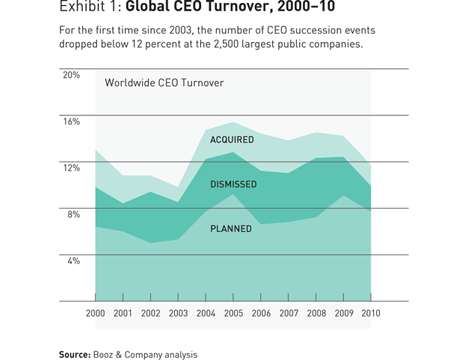
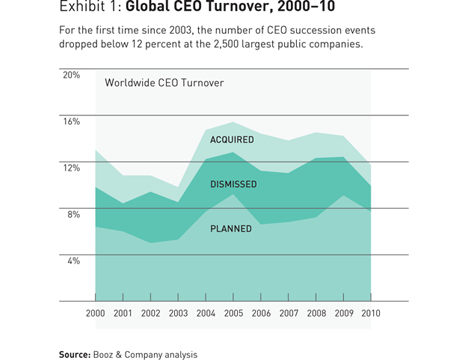
Booz & Company’s annual study of CEO succession suggests yet another reason why culture change is infrequently attempted, much less accomplished, and why culture change itself all too rarely remains at the forefront of business thinking: average CEO tenure is too short to see it through to the end.

The math is straightforward:  culture change is considered to take, all things considered, about 5 years (see notes below). CEOs brought in from the outside, that is, those most likely to have an independent view of a corporate culture, and therefore to be able to see the ways in which a corporate culture hinders performance, currently last on average 4.3 years.  You do the arithmetic.

The simple fact is that outside CEOs don’t have the time to change the culture of a company, particularly given that they’re under the most pressure to demonstrate early wins. So they don’t even try. Or, if they do so, it’s a superficial attempt at best.

The issue is different for CEOs who came from inside the company. According to Booz & Company, inside CEOs currently last on average 7.1 years, surely enough time to initiate and complete a culture change.

Two issues, however, press against their successfully changing a corporate culture. The first is methodological:  The seven-year figure may very well overstate the actual length of inside CEO tenure, for a number of reasons:

  1. Chinese companies, most of them are state-owned and controlled, and with half the turnover of everyone else, make up an increasingly significant proportion of the top 2,500 companies globally.  Their presence reduces the overall level of CEO turnover globally and exaggerates the average length of CEO tenure.
  2. The “Great Recession” has lowered CEO turnover and lengthened average tenure as boards sought to maintain a sense of continuity and a “steady hand” in the midst of market turmoil.
  3. A statistical anomaly: there have been so much turnover in recent years among CEO ranks that many CEOs haven’t been there long enough to be counted among those turned over.


But even if the arithmetic is better for inside CEOs, there’s a second problem to their successfully changing their corporate culture: the very fact that they’re “insiders”. That is, if they’ve been in a company long enough, the odds are they’ve so deeply internalized the existing culture that they may no longer be aware of the ways it biases their judgment and decision-making. Additionally, since their success is at least, in part, a result of their mastery of the existing culture, there is less reason for them to change it, even if they could see it objectively.

Bottom line: changing corporate culture is hard. Successes are few. CEOs are almost structurally incented to minimize the need for it, ignore its impact, or only touch it superficially.  Not good news if your corporate culture has become a barrier to your business success.

*****

Notes on changing corporate cultures: for insight on the on length of time for successful corporate change, see, for example, Harvard Business School change guru John Kotter’s Culture Change and Performance, p. 105, or pioneering industrial psychologist Edgar Schein’s classic, Organizational Culture and Leadership. For research on the rarity of successful corporate culture change, see Martin E. Smith’s article, “Changing an organisation’s culture: correlates of success and failure.”

Posted in Corporate Culture Change | Tagged , , , | 5 Comments

Why tell “why?” (1)

Not too long ago, I was brought in to help a global corporation’s employees make sense of a vast change initiative. Or initiatives, to be exact. 35 in all. What the company wanted was an umbrella “brand” for all 35 change initiatives, and an overall strategic message to frame the initiatives and help employees make sense of them, and see that they fit together.

Good idea. I was only too happy to help. And of course, I told them, as part of developing a strategic message, its basic structure would have to incorporate not only the “what” of the strategy, but the “why,” as well.

“No, I’m sorry we can’t do that.”

Can’t do what?

“Tell people ‘why.’ We don’t do that around here.”

Don’t do that around here?! But you’ve had something like three presidents in five years, and at least as many change initiatives. And none of them have succeeded.  You not only need to tell them “why” change is needed, but more specifically, why this set of change initiatives are more likely to work than those that have already failed.  Nothing else is likely to make them commit to this change. Experience has taught them that the easiest and safest road for them is simply to wait it out until the change effort fails, this president is fired and a new president and new change initiative comes in. Why is this time any different?

“Sorry. We don’t tell people ‘why’ in this company.”

*******

There’s a multitude of overwhelming, compelling reasons why you tell people “why” if you want them to change:

  • First, and most importantly, they’re much more likely to do what you need them to do when you tell them why. In fact, as Harvard psychologist Ellen Langer has shown, simply using the word “because” by itself may get compliance from your employees, apparently without their even thinking about it.
  • Second, people are inherent rationalizers (which is not the same thing, in fact, often quite the contrary, of saying they are inherently rational.)  If you don’t tell people “why” you want them to do something, they’ll make up a reason themselves. Their reasoning and yours are unlikely to be synonymous – after all, they don’t know yours – and may undermine the very change you champion.
  • Third, fourth, fifth and more, you’ll elicit gratitude, build good will, reduce uncertainty, build community and a sense of relatedness and enhance your credibility. To name a few.

Given the powerful logic of supplying a rationale for change – which most senior leaders are smart enough to do – the more interesting question than “Why tell ‘why’?” may be “Why wouldn’t leaders tell ‘why’?”

Posted in Uncategorized | Tagged , , | 3 Comments

Why tell “why?” (2)

Why wouldn’t leaders tell their followers the “why” behind change?

Not a question I hear frequently, perhaps because it’s not easily answered. In fact, there may be no single, simple answer.  Individual leader’s reasoning on this may be quite idiosyncratic – dependent on the particular context and individuals involved – and therefore not generalizable.

That said, I want to dip my toe into “theoretical la-la land” for a moment, and posit a possible shared trait among senior leaders who are reluctant to or won’t tell their people the “why” behind a change initiative.

Have you met leaders who fit this bill:

  • Having a sense of entitlement, i.e., unreasonable expectations of automatic compliance with his or her expectations?
  • Lacking empathy, so unwilling to recognize the impact their actions have on the feelings or needs of others?
  • Arrogant in their behavior or attitudes?

It would not be a surprise if most of you nodded your heads as your read through these descriptions. But would it surprise you to find out that they were derived from the discussion of narcissism in the Diagnostic and Statistical Manual of Mental Disorders (IV)? It surprised me.

Posted in Uncategorized | Tagged , , | Leave a comment

Why tell “why?” (3)

Okay, I know that we’ve taken a huge leap here, from the case for incorporating the “why” behind change into strategic leadership communication to suggesting narcissism as a cause of non-communication.  A leap that could land me in a heap of rolling eyeballs.  But hang glide with me a minute.

The inspiration for this turn came from a provocative interview with Manfred F.R. Kets de Vries, the Raoul de Vitry D’Avaucourt Chaired Clinical Professor of Leadership Development, and founder of the Global Leadership Business Center at INSEAD business school.  (His title itself is inspirational!)

De Vries basically suggests, first, that all senior leaders are probably narcissistic – not a bad thing – and second, that narcissism in leaders exists along a continuum from constructive (or creative) to destructive. Narcissism in moderation, he suggests, may be necessary, a source for assertiveness, self-confidence, and creativity.  “People who achieve things,” he says, “have to be somewhat narcissistic, or they wouldn’t be motivated to excellence.” At the other end of the continuum, destructive narcissism can be inordinately, well, …..  destructive, taking down companies, destroying shareholder value, and negatively impacting people’s lives.

The point here is not to indulge in any deep analysis of narcissism in business – a deep pit, indeed – but to suggest one possible answer to the question: “Why don’t some leaders tell ‘why’?” It may be that some leaders are narcissistic enough to assume that if they think it’s the right thing to do, that should be enough.

******

Whether or not narcissism has anything to do with why leaders ask employees to engage in change initiatives without telling them “why”, one thing is sure: not providing a compelling rationale for change doesn’t work.

Case in point: the CEO who wouldn’t tell his people “why” they should implement his 35 change initiatives. Shortly after I had (happily) left my consulting engagement with them, he was heard shouting to his inner team, in a voice full of obvious frustration, “I told them what to do!  Why won’t they just do it?!”

He was gone within a year and a half. But not before dragging a lot of people down with him.

And his company?  Still in decline. No need to answer the question, “Why?”

Posted in Uncategorized | Tagged , , | Leave a comment

The making of a minor communication disaster (1): It’s not what you say, it’s who you are

It was fairly early in my career. I was the de facto lead speechwriter for Digital Equipment Corporation (DEC) – at that time, the number two computer company in the world. The event was DECWorld, a one-company trade show that brought in some 10,000 senior corporate and government officials from around the globe. One of my roles at that year’s DECWorld was to manage an event – “An Evening with Bill Gates,” then still a very active chairman of Microsoft – for 1,000 Digital customers.

Working to outline content and messages for Gates’ presentation with the very smart, very focused, and utterly uncompromising Microsoft team was painful. After protracted negotiations, we reached a last-minute accord on content that would work for both our companies and our customers.

The review of the material with Bill Gates took place only a short time before he was to speak. At the table were Ken Olsen, DEC founder, chairman, and computer industry pioneer and legend, Bill Gates, utterly respectful and clearly admiring of Olsen, Gates’ personal PR person and me.

We walked Gates through the presentation: the audience, messages and key points, explaining our rationale, logic, and understanding – why we thought it would all work.

Gates listened respectfully, nodding his head, understanding.  Then, after a long pause, Gates looked at us, and said, “No.” No? “I don’t want to say that.”  Excuse me? “I want to talk about something else.”  What?  “My house.”  Your house? “My house.”

His house: a custom-built, 66,000 square foot monster boasting a beyond state-of-the-art technology infrastructure, and a world-class collection of digitalized art, masterpieces for which he had garnered exclusive digital rights.

Gates was relaxed, boyishly charming, and very likeable. The talk flowed easily, and featured no discussion of business, technology, or DEC, for that matter.

And yet…. somehow… a very strong message came across: Microsoft can and should be your corporate partner (independent of whether you go with DEC or not!). I heard it loud and clear. So did our customers.

Not good. For DEC. Or Me. And not what we had negotiated.

Posted in Uncategorized | Tagged , , , , , | 1 Comment

The making of a minor communication disaster (2): It’s not what you say, it’s who you are

How did Gates do it? How did a powerful Microsoft message emerge from his homespun talk about his home?

The answer is rooted in the nature of communication itself. Simply put, all communication comes across on three basic levels: content (what you have to say), identity (how you come across saying it) and relationship (how you want to relate to those with whom you’re communicating). Consciously or not, your listeners pick up all three.

Gates was smart enough to understand that tech talk by itself might not fly in this venue; he knew that to a tried-and-true, hard-core computer engineer like Ken Olsen, Microsoft products would undoubtedly be perceived as technically shoddy. So he sought to establish a relationship with this group of potential corporate customers based on who he is, rather than on the products he had to sell.

Everything Gates talked about, then, worked on two levels:  on the surface as straightforward content (“my house”), and underneath that, as an identity message. There were two dialogues going on at once:

What Gates Said What Gates Communicated
“I am building a 66,000 square foot house….” “I’m very rich and very successful. An awful lot of customers must think I’m doing something right!”
“…. with a sophisticated information technology infrastructure…”. “I understand how all the elements of technology fit together as well as anyone, including DEC. You can trust me as a corporate technology partner.”
“…. populated by digital reproductions of great masterpieces…” “Olsen may be a pioneer, but I’m a visionary. The world is going digital, even art. And it’s all software, where I excel. If you want to be part of the future, work with me.

Gates got both levels of his message across.

The lesson I took away from that evening: Much of the communication failure of senior leaders comes when they focus solely on what they want to say rather than on how they are coming across or how they are relating to those with whom they are communicating.  The latter two can completely shut off, outweigh, or invalidate the former.

Gates understood that perfectly.  Olsen didn’t have a clue. The evening had not been all that good for DEC.  And it was about to get worse.

Posted in Uncategorized | Tagged , , , , , | Leave a comment

The making of a minor communication disaster (3): It’s not what you say, it’s what you symbolize

Bill Gates had finished his presentation to a healthy round of applause and appreciation. Ken Olsen got up from our table and started walking toward the stage to thank Gates and end the evening. But just as he started walking up the steps to the stage, Gates had a sudden change of heart. “I can take some questions,” he said.

To understand what happened next, you have to understand this: Olsen’s ethos was the antithesis of Gates’.  Olsen was a dyed-in-the-wool computer engineer: he had directed the building of the first transistorized research computer; he held engineering patents; he had two degrees from MIT. He believed that the best ideas and best technology would always win out.

Gates understood technology well, but the business of technology better. He also understood, unlike Olsen, that technology, by itself, didn’t sell anything. Except, perhaps, to engineering perfectionists like Olsen.

As Olsen stood on the stairs to the stage, Gates started taking questions.  Olsen had only to walk down a couple of stairs and about 15 feet to return to our table. But he decided to stay put, and sat down on the steps to the stage.  At Gates’ feet.

In that one picture – Olsen at the feet of Gates – Olsen visually expressed the very messages he hoped the evening would avoid: the generational transition from computer industry pioneers like Olsen to the next generation of leaders, embodied in Gates; the diminution of the mainframe/minicomputer era before the rise of the PC; the commoditization and consumerization of hardware and the explosive, margin-rich growth in software.

An awful lot of symbolism in one simple gesture. But that’s exactly what a symbol does: pack a whole set of underlying information, attitudes, values, meaning, history, norms, etc. into one simple visual representation.

It was an obvious gaffe, and I frantically gestured to Olsen to come back to our table. But his mind was somewhere else. He had no understanding of others’ perceptions; or if he did, he didn’t care; after all, for him, it’s engineering quality that sells technology, not symbols. Where was the harm?

Maybe he had a point. After all, there were only 1,000 people in the room. And not all of them would leave with the picture of Olsen at the feet of Gates burned in their memories.  They had no place else to burn the picture anyway: There was no You Tube. Or Facebook. Or Twitter.  Camera phones didn’t exist. Who would remember Ken Olsen sitting at the feet of Bill Gates?

Nobody, I hoped. And my hopes held up. For about six hours, anyway. Until the first editions of the next day’s Boston Globe came out. And there it was: page one, upper center, headline level – a disproportionately large color photo of Ken Olsen sitting at the feet of Bill Gates….

I didn’t lose my job over that picture. Quite the contrary. Olsen couldn’t have cared less about it. And DECWorld as a whole more than paid for itself in new orders. That evening was swept up in the overall success of the event.

But that picture was a lingering symbol that prefigured the future perfectly, a future that all-too-soon became a reality: the forthcoming fall of Olsen – fired by his own board of directors; and the decline and ultimate demise of Digital Equipment Corporation.

Ken Olsen, innovative computer engineer that he was, never got the power of something as ephemeral as a symbol.  And, for that matter, far too many leaders still don’t.

But I did, and all too well…

I left DEC not long afterward. There was no symbolism in it. Only reality. And as I learned that night, and have counseled leaders ever since, it’s important not to confuse the two, or to let lack of awareness turn one into the other.

Posted in Uncategorized | Tagged , , , , , | Leave a comment

How do you know a leader is a strategic communicator?

I’ve worked with a lot of very senior leaders in multiple industries in multiple countries.  What separates those leaders who communicate strategically from those who don’t?  Simple. Leaders who are NON-strategic communicators focus on what they want to say. Leaders who communicate strategically start with what it is they need their people to do in order for their businesses to succeed.  Then they focus on what needs to happen to get those people there, including what communication is necessary.

Posted in Uncategorized | Tagged , , | Leave a comment