
Finding corporate cultures to admire is easy. Changing your corporate culture to make it easy to admire is not.
(For suggestions on why that is the case, see the previous blog entry, “Benchmarking Better Cultures? Don’t!”)
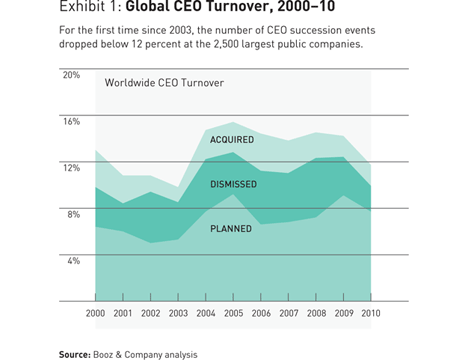
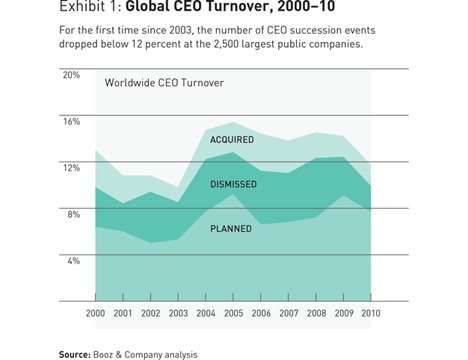
Booz & Company’s annual study of CEO succession suggests yet another reason why culture change is infrequently attempted, much less accomplished, and why culture change itself all too rarely remains at the forefront of business thinking: average CEO tenure is too short to see it through to the end.
The math is straightforward: culture change is considered to take, all things considered, about 5 years (see notes below). CEOs brought in from the outside, that is, those most likely to have an independent view of a corporate culture, and therefore to be able to see the ways in which a corporate culture hinders performance, currently last on average 4.3 years. You do the arithmetic.
The simple fact is that outside CEOs don’t have the time to change the culture of a company, particularly given that they’re under the most pressure to demonstrate early wins. So they don’t even try. Or, if they do so, it’s a superficial attempt at best.
The issue is different for CEOs who came from inside the company. According to Booz & Company, inside CEOs currently last on average 7.1 years, surely enough time to initiate and complete a culture change.
Two issues, however, press against their successfully changing a corporate culture. The first is methodological: The seven-year figure may very well overstate the actual length of inside CEO tenure, for a number of reasons:
- Chinese companies, most of them are state-owned and controlled, and with half the turnover of everyone else, make up an increasingly significant proportion of the top 2,500 companies globally. Their presence reduces the overall level of CEO turnover globally and exaggerates the average length of CEO tenure.
- The “Great Recession” has lowered CEO turnover and lengthened average tenure as boards sought to maintain a sense of continuity and a “steady hand” in the midst of market turmoil.
- A statistical anomaly: there have been so much turnover in recent years among CEO ranks that many CEOs haven’t been there long enough to be counted among those turned over.
But even if the arithmetic is better for inside CEOs, there’s a second problem to their successfully changing their corporate culture: the very fact that they’re “insiders”. That is, if they’ve been in a company long enough, the odds are they’ve so deeply internalized the existing culture that they may no longer be aware of the ways it biases their judgment and decision-making. Additionally, since their success is at least, in part, a result of their mastery of the existing culture, there is less reason for them to change it, even if they could see it objectively.
Bottom line: changing corporate culture is hard. Successes are few. CEOs are almost structurally incented to minimize the need for it, ignore its impact, or only touch it superficially. Not good news if your corporate culture has become a barrier to your business success.
*****
Notes on changing corporate cultures: for insight on the on length of time for successful corporate change, see, for example, Harvard Business School change guru John Kotter’s Culture Change and Performance, p. 105, or pioneering industrial psychologist Edgar Schein’s classic, Organizational Culture and Leadership. For research on the rarity of successful corporate culture change, see Martin E. Smith’s article, “Changing an organisation’s culture: correlates of success and failure.”


 Strategic Leadership Communication
I agree with the perspective of CEO tenure and its impact on corporate culture change. In my experience working with culture change, the most important element to address this limitation is to get the entire top team to see the link between culture and business performance; this creates a mandate for change that transcends the CEO’s length of tenure. It is a relatively under-appreciated approach to take, but one many organizations are finding successful. By cultivating buy-in and support from the top with a solid business metric to measure culture’s impact on performance, you can sustain the 5-7 year time frame to embed meaningful change throughout the business.
Lisa, thanks for the insightful comment. Of course, you’re right that creating a link between corporate culture and business performance, and enlisting the entire top team in the culture change effort, is the way to elevate culture change on the leadership agenda – relatively independent of the tenure pressure on the top leader.
At the same time, the necessity to make the connection underlines the fact that the ways in which corporate cultures frame and often limit business performance are, unfortunately, not self-evident to leadership teams.
Very insightful perspective. Functional leaders, like CMOS often face a similar conundrum. Short average tenure means less incentive to invest in the hard things like building marketing capability that take a while to pay out, and more to redo the corpirate advertising campaign, etc. Good lesson for those responsible for corporate governance.
I’m not sure I buy the idea that culture change is necessarily such a long-term thing. I think it’s much more situational, and depends on whether an organisation has certain behaviors and processes that can have big repercussions if changed. Indeed, maybe culture change is more of a side-effect of other change rather than something best pursued on its own. Just a thought.
Mike, while I appreciate your comment, the case for the difficulty of changing culture is pretty strong, and the research supports it. The best explanation for this my be that of Organizational Psychology guru Edgar Schein, who suggests that at the deepest level, a corporate culture, with its attendant norms, values, and behaviors is so deeply internalized by members that they can no longer distinguish it as a “culture” independently of reality. It is reality. You don’t change reality easily.
I experienced this first hand during the extended culture change efforts that YUM Brands (Pizza Hut, KFC, Taco Bell) made in its efforts to embed a restaurant-focused culture in the deep soil of PepsiCo’s consumer packaged goods culture. Five years down the road, fabulous progress had been made. But there was still much about the way the organization worked that still shouted, “PepsiCo,” sometimes to the detriment of its goals.
Of course, the state of any particular corporate culture at any moment time is highly variable. And the five year estimate for successful culture change is more a rule of thumb than a hard and fast limit. Some corporate cultures are weaker than others. Some have strong subcultures that provide a model and basis for the change, delimiting its difficulty. In that sense, you’re right, there is a situational dimension to any one change effort, and some efforts therefore can move more quickly than others.