The Best Ideas Don’t Win, The Best Advocates Do: An Interview With John Daly, Author of Advocacy: Championing Ideas and Influencing Results (Part 4)

John Daly, one of the world’s leading communication experts, is the Liddell Centennial Professor of Communication, TCB Professor of Management and University Distinguished Teaching Professor at the University of Texas, Austin.

In Part 1 of the interview, we discussed why there’s a need for a book on becoming a better advocate for one’s ideas. In Part 2, we discussed the skills necessary for effective advocacy. In Part 3, John talked about some of the counter-intuitive notions necessary for successful advocacy. In the final part, Part 4, below, we review some of the key mistakes advocates make, the key barriers they face, and what advocates need to do to overcome them.
Strategic Leadership Communication:

What are the common barriers that get in the way of successful advocacy; what is the most common mistake advocates make?

John Daly:

The most common mistake that people with ideas make is not believing that they have to advocate at all.  They say, “Here’s the document, here’s the white paper, here’s the prototype. Approve it.” They think the solution is obvious, and we ought to do it. And they can’t understand why people would argue against it.

Or they think advocacy means coming up with a great slide deck.  Well, guess what? It’s not starting to matter anymore how great your slide deck is, because presentations are going away in companies. Now, when you walk into a meeting to present, people say, “I’ve already looked at your slide deck, and I’ve got a few questions.”  So, in place of your ability to come up with a great slide deck, your success as an advocate today is more likely to come from your ability to answer people’s objections and questions. The problem is that most people don’t think that way. They’ll spend days working on their slides, and then they’re absolutely floored when anyone disagrees with them.

Strategic Leadership Communication:

Once you’ve realized you have to advocate, and that simply presenting your idea is not enough, what else gets in the way of advocating successfully?

John Daly:

Managing your timing.  Timing is everything in advocacy: If your company is in cost cutting mode, the timing may not be right to call for a major investment. If it’s “top-line” focused, desperate to generate revenue, you may want to wait before you put all your chips behind a proposal for incremental improvements in efficiency.

Strategic Leadership Communication:

That just sounds like common sense. Of course, I’ve had to work with clients so caught up in the spell of their ideas that they find it too hard to hold back . Still, even a small dose of awareness, and a dash of strategic thinking, should provide some restraint on poor timing.

John Daly:

That’s certainly true to a degree. But it’s also true to some extent that you can create your own timing.

Strategic Leadership Communication:

How so?

John Daly:

By making sure that, as an integral part of your advocacy efforts, you answer the question: “Why should we do it now?” It’s one of the most important questions advocates can answer, but so few of them do. If your company can wait three years to do it, why do it now? If you should have done it four years ago, why do it now?  You’ve got to convince the decision makers that this is the right moment; and remember, that’s a perception, not necessarily the reality.

Of course, it’s also true, as you suggested, that you have to think strategically about timing. Let me give you a simple example. We know most companies’ budgets end in December.  So if you want to pitch a training course, or buy a small piece of technology, when do you pitch it?  November. Why? Because if it isn’t spent then, you’re going to lose it. So you might as well spend it.

Now that’s obvious to people like you and me, but a lot of people simply don’t think in terms of, “Wait until the end of the year when there’s excess money.” However, it’s not rocket science. It’s just thinking about whether, yeah, this is the right moment, or, if it’s not, figuring out how to make it the right moment. Even the most technical of people are smart enough to do that.

Strategic Leadership Communication:

Some of the people I’ve worked, and I’m sure some of the people you’ve worked with as well, don’t need to think about timing at all, they simply “get it;” they know, almost instinctively, when the timing is right or how to make it seem right.

John Daly:

Absolutely.

Strategic Leadership Communication:

So the question is: what distinguishes those who have “it” from those who don’t? Why is it that some people have an almost instinctive sense of timing for what they want to propose, while others don’t have a clue?

John Daly:

I’m convinced that it’s simply a result of the way that some people are raised.  I think that if you grew up in a big family, you’ve probably learned the politics of competing for what you want better than if you’re an only child. It also depends on how manipulative you were with your parents, too. Some kids want things from their parents, other kids don’t. Some people have spent time trying to read the moves of those they want to persuade, other people haven’t.

Strategic Leadership Communication:

My guess is that most of the target audience for this book – scientists, engineers, and other technical experts – may be excellent readers of written material, but not of people. It just seems to be the case that those who have really worked hard to develop top-notch analytical and cognitive skills may not have made the same investment in those tacit and relational skills that are needed for successful advocacy.

John Daly:

That’s one reason I’ve structured the book to provide a kind of framework for building skills.  On a chapter-by-chapter basis, you get a coding system, a schema, if you will, for understanding what works and what doesn’t in advocacy – whether for framing the right message, demonstrating confidence, steering a meeting the right way, forming alliances, sensing the right timing.

It’s necessary because there’s way too much “stuff” in the book to take every action it recommends. You’d be overwhelmed.

What you can do, though, as a start, is to learn to use the coding system from the book to clearly recognize the mechanisms of advocacy at work around you. Think of yourself – if you enjoy sports, for example – as learning enough from the book to be able to provide the play-by-play and color commentary at a meeting where decisions are being made:  “There she goes, she’s interrupting. Aaaah, she got shot down. Let me tell you why she got shot down – these three reasons.” Or, “Ah, he’s talking now, he’s getting what he wants. What did he do?! Simple, he did A, B, and C.”

Strategic Leadership Communication:

Step one, then, is to use this book to build your awareness of what generates the outcomes, whether successful or unsuccessful, of the advocacy efforts around you.

John Daly:

That’s right.  In fact, that’s probably the most important thing in the book for a lot of people. That, by itself, will be helpful.

Strategic Leadership Communication:

What comes next?

John Daly:

The second step is to take that awareness and apply it to yourself, to your own efforts: “That worked well because of this.” Or “It would have gone better had I remembered to do A and B, instead of C and D.” Doing that will help make you a smarter, more strategic, and more successful advocate.

And finally, there’s step three, where you would target those areas where you’re least effective – coming across confidently, or framing proposals, for example – and focus on a couple of behaviors needed for improvement, and then practice them.

Strategic Leadership Communication:

One final question. In working with people on building influence or advocacy skills, some of my clients, and undoubtedly some of yours, have raised the concern that following these kinds of recommendation seems manipulative, Machiavellian even.  How you do you respond to them?

John Daly:

Look, there is a common fallacy called the “just world hypothesis;” that in the end good will always triumph. Well, it’s very much like the idea that the best ideas will always win. Reassuring to believe in, but demonstrably false.

Machiavelli is often thought of as immoral; somehow on the side of evil.  But he was really amoral. He said, in essence, “This is what it takes to win. You can do it or not do it.  It’s your choice. But know this: someone is going to take advantage of these behaviors to sell their ideas – which may be far inferior to yours. So your choice is either to do what it takes to advocate successfully for your ideas, or let someone else do it and have their ideas win.”  My role is to say that if you’re going to advocate successfully, here’s what it takes.

That ends the four-part interview with John Daly, author of “Advocacy: Championing Ideas and Influencing Others.” Earlier parts can be found at http://strategicleadershipcommunication.com


Posted in Communication and Cognition, Persuasion and Influence | Tagged , , , , , | Leave a comment

The Best Ideas Don’t Win, The Best Advocates Do: An Interview With John Daly, Author of “Advocacy: Championing Ideas and Influencing Results” (Part 3)

John Daly, one of the world’s leading communication experts, is the Liddell Centennial Professor of Communication, TCB Professor of Management and University Distinguished Teaching Professor at the University of Texas, Austin.

In Part 1 of the interview, we discussed why there’s a need for a book on becoming a better advocate for one’s ideas. In Part 2, we discussed the skills necessary for effective advocacy. In Part 3, below, John talks about some of the counter-intuitive notions underlying successful advocacy.

Strategic Leadership Communication:

One of the distinguishing features of your book is that everything you recommend is rooted in specific, footnoted empirical research – beautifully integrated into the text, by the way.

John Daley:

Thank you.

Strategic Leadership Communication:

So it’s all valid and verifiable. And yet, so many of your suggestions seem contrary to people’s social intuitions.

John Daley:

It’s true. Many of our common sense notions and strategies for successful advocacy turn out to be misleading at best, and sometimes simply wrong.

Strategic Leadership Communication:

For example?

John Daley:

Networking, for one. You’ve all heard the phrase, “It’s who you know that matters.”  In reality, that’s irrelevant.  It’s who knows you that matters. The goal of networking is not to meet a lot of people; it’s to get people to remember you.  A lot of people make that mistake. They go to a lot of “meets and greets,” and they forget the goal is to get people to remember you.

Strategic Leadership Communication:

I may be one of them. It’s certainly a widely-shared impression that networking is a quantity game, isn’t it? The more people you round up, the more likely you are to garner support from someone?

John Daley:

You don’t want to go after people; you want them to come to you. If somebody is looking for top-notch expertise, do you come to mind before anyone else? That’s what real networking is.  You may have met me 15 times, but if I don’t remember you, it doesn’t matter.

Strategic Leadership Communication:

The point then, if I hear you right, is to network in order to generate what marketers would call, “top-of-mind awareness.”

John Daley:

Exactly.

Strategic Leadership Communication:

So quantity doesn’t matter; it’s all about the quality of the social interactions?

John Daley:

Quantity does matter.  But the key point is that you’ll be successful, not when you want to be successful, but when other people want you to be successful.  Getting them there is the goal of networking.

Strategic Leadership Communication:

Got it.  Another area where our intuitive notions may work against our advocating successfully?

John Daley:

Favors. Reciprocity.

Strategic Leadership Communication:

Reciprocity? You scratch my back; I’ll scratch yours? That’s a bedrock principle of social influence; what’s counter-intuitive about that?

John Daley:

The bedrock is a bit shaky, I’m afraid. Let’s take a simple example. If I do you a giant favor, who owes whom?

Strategic Leadership Communication:

I owe you.

John Daley:

Not necessarily. More likely, I owe you. In fact, I may owe you even more if the favor is large enough.

Strategic Leadership Communication:

Wait a minute. You’re saying that if you do me a big favor, instead of me owing you, you owe me even more? That doesn’t make sense…. Which, of course is why it’s counter-intuitive, I guess.

John Daley:

It’s true that every time I do you a favor, you may indeed feel a sense of obligation. But look at it from my point of view: I’m investing in you and your success. And if I keep on doing that, in large and small increments over time, at some point, I’ve put so much work into making you successful, I’m not going to allow you to fail. Because at that point, if you fail, I do, too – it reflects back on me.

It’s like when you’re first starting your career, when some higher ranking, more experienced colleague adopted you – helped you out once, got you onto a project, or new assignment, made sure you didn’t get in trouble. By the time you’ve been there for a few years, this mentor is opening up career opportunities for you to jobs you didn’t even know existed.

Strategic Leadership Communication:

So, as someone who wants to advocate, the behavioral implication is…?

John Daley:

Ask people for favors.  When people do you a favor, they’re actually investing in you.  So, for example, when you have a question, ask for someone’s advice instead.

Strategic Leadership Communication:

I’m not sure how that follows.

John Daley:

When you have a question, and it has either a right or wrong answer, it feels interrogatory.  If instead, you say, “I need your advice; I’m turning you into my personal consultant,” it makes them more committed to you in some ways.

Strategic Leadership Communication:

So, ask not what I can do for you; ask what you can do for me – because the more you do, the more you’ll feel obligated to do.

John Daley:

That’s the reality of how it works.

Strategic Leadership Communication:

We’ve talked a lot about engaging others to invest in you; what about something that you as an advocate can do yourself to increase your chances of success, but that may be at least a bit counter-intuitive?

John Daley:

One of my favorites in the book is this: you don’t want to sell solutions, you want to sell problems.

Strategic Leadership Communication:

I thought the idea was to solve problems, not sell them?

John Daley:

Selling problems is actually how you sell solutions. Really smart advocates don’t say, “I want to do x.” They create in the decision maker’s mind a problem, and then they hope the decision maker comes up with a solution close to what they have in mind.  This is what the greatest companies in the world do as well: they don’t sell solutions, they create problems you’ve never had before.

Strategic Leadership Communication:

For example?

John Daley:

For example, booksellers in the 1920s wanted to increase sales. What did they do? They convinced homebuilders to create built-in bookshelves in people’s homes. And once you have built-in bookcases, you have a problem: you have to fill them up.  So book sales increased. Grocery sales skyrocketed in the 1930s because a man in Oklahoma created the grocery cart. Once you have a grocery cart, what do you have a need to do? Fill it up!

Strategic Leadership Communication:

What happens when the problem is solved, or someone comes up with a competing solution?

John Daley:

You’d be surprised at the ingenuity that’s possible when you start manufacturing problems instead of solutions. Take Arm & Hammer baking soda, for instance. It was used for baking for 100 years. In the 1990s, however, with more people working outside the home, fewer and fewer had the time to bake. And so fewer and fewer needed baking soda.

So, Arm & Hammer created a new problem: odor in your refrigerator. People my age don’t remember a “refrigerator odor”. It was just the smell of the refrigerator. It wasn’t any big deal. Until Arm & Hammer created the “refrigerator smell.”  Boom! Sales go back up.

And then, around 2000, the plot thickens when the refrigerator manufacturers started making refrigerators that had a nice scent. So, Arm & Hammer, endlessly inventive, created a new problem that we didn’t know we had before: odor in the garbage disposal.  This is an extraordinary business concept when you think about it: You take your hard-earned cash and go to the store and almost literally pour that money down the drain! You never knew you had a problem with your drain before.

Strategic Leadership Communication:

Built-in bookcases, grocery carts, baking soda: they’ve all been around for decades and decades. Do you have a more recent example?

John Daley:

Absolutely. Probably the most recent example is in Europe. You probably have 15 cell phone chargers at home, right? Okay, at least more than one – one for every phone. After all, for every phone – Apple, Samsung, Nokia, HTC – you have a separate, incompatible charger.  Why does every phone have a separate charger? Huge markup. Huge money-maker.

Well, starting this year in Europe, every phone will use the same identical charger. You know how they sold it? It wasn’t convenience. It wasn’t money.  The problem statement was… the environment. Why the environment? Well, ensuring the quality of the environment is a deeply held value in Europe. And, guess what? Every one of those chargers goes in the ground at some point and leaches weird chemicals for something like the next 50 years.

The advocates for the universal charger were not successful until they found the right problem.  Once they found the right problem, the answer was obvious.

Strategic Leadership Communication:

Thinking problems first, not solutions, does seem to go against the grain.

John Daley:

The point is that we’ve all been taught to sell solutions. But what I want you to do as an advocate is to create a problem in someone’s mind they didn’t know they had before.

That ends part three of the interview with John Daly, author of (Advocacy). In the fourth and final part, Daly reviews some of the key mistakes advocates make and key barriers they face, and talks about what they need to do to overcome them.

Posted in Communication and Power, Persuasion and Influence | Tagged , , , , , | Leave a comment

The Best Ideas Don’t Win, the Best Advocates Do: An Interview with John Daly, Author of “Advocacy: Championing Ideas and Influencing Results” (Part 2)

John Daly, one of the world’s leading communication experts, is the Liddell Centennial Professor of Communication, TCB Professor of Management and University Distinguished Teaching Professor at the University of Texas, Austin.

In Part 1 of the interview, we discussed why there’s a need for a book on becoming a better advocate for one’s ideas. In Part 2, below, we discuss the skills necessary for effective advocacy.

Strategic Leadership Communication:

What are the skills necessary to become a successful advocate? Is there some easy formula someone can follow?

John Daly:

There is no easy formula; I wish there were. I have a formula, but it’s not easy by any stretch of the imagination.

Strategic Leadership Communication:

By “formula,” you mean a set of skills?

John Daly:

Five basic skills, capabilities, or actions that people have to master to be successful advocates.

Strategic Leadership Communication:

And they are?

 John Daly:

First, be able to explain their ideas well, so people can understand and remember them. Second, they’ve got to build a reputation so that people trust them and respect them. Third, they’ve got to get other people to work with them on the idea – partnering, if that makes sense. The day of the scientist working all by herself in the dusty garret is gone. Fourth, they have to presell the idea, and to my mind, that may be the most under-rated of all of the things needed for successful advocacy.

Strategic Leadership Communication:

Why is preselling, in particular, so important?

John Daly:

We’ve all seen people come to a meeting with a deck of slides, and say, “Here’s my proposal.” And they often get shot down.  Other people’s ideas just seem to happen.  This is because those people are so good at preselling.  The reality is that in most organizations, the bigger the decision is, the more it has been sold before any formal meeting actually happens. So to advocate successfully, you have to prepare people to hear your idea before the meeting, one person at a time if necessary. If you don’t, it’s really easy to lose control of it during the meeting.

Strategic Leadership Communication:

You said five skills were necessary for successful advocacy. What’s the fifth?

John Daly:

The fifth one is being influential.

Strategic Leadership Communication:

Influential? If you’re already have a good reputation and have built strong relationships and partnered on your proposal, why wouldn’t you already have influence?

John Daly:

Most of us know, and the research supports the fact, that likeability counts, that if people like you, they’re more likely to buy your ideas than if they don’t.  The same with reputation: if you have a great track record, you’re more likely to get your ideas sold. So, both who you are and with whom you’ve worked certainly open up the possibility of influence.

But they don’t guarantee that you’ll close the sale—get decision-makers to approve your idea and fund it. It is not uncommon for very likeable people with great track records to fall flat on their faces when it comes to getting their ideas approved and funded.

Strategic Leadership Communication:

Because they lack influence skills?

John Daly:

First, because most of them don’t know they even need influence skills. They think it is enough to walk into a meeting, and say, “Here’s the data. Look at the data. It says we should do x rather than y.”  Then they’re shocked when the company goes y rather than x, because someone else was able to successfully influence people, independent of the “facts.”

Second, even if knew they needed to exert influence, they don’t know how. They may be deeply liked by their peers, and deeply respected by their bosses. But when they go into the key decision-making meeting, they may stay quiet, not know where to sit, not know how to show themselves to advantage, and guess what, they don’t get their programs approved.

Strategic Leadership Communication:

You keep referencing meetings as important moments for advocacy both in our discussion and in your book.  Why?

John Daly:

Meetings are where ideas compete for limited resources and where the winners walk away with the resources and the loser’s ideas are left to die.  They’ve become the modern equivalent of the Roman Coliseum, where modern gladiators fight it out.

That’s why, if you’re going to propose an idea at a meeting, the ability to walk into it and make it your own is an absolutely vital skill. And that’s why I devoted a whole chapter to how take over a meeting when your ideas are on the line.

Strategic Leadership Communication:

Make a meeting “your own?”

John Daly:

Come across confidently. All the research tells us that if you sound confident, you’re generally perceived to be competent. That turns out to be an issue for a lot of technically excellent people, scientists, for example, who have been raised to be really tentative about things.  And if you’re among a group of scientists, being tentative is really important.

But if you go out in public asking for support, you can’t be tentative. You can’t say everything’s an empirical question. You’ve got to make a very declarative statement: “This will work. You’ve got to invest in this idea.”

It’s a tough lesson to learn that being liked and respected is not a substitute for having the skills to come across confidently, and to therefore be seen as competent, and worth investing in.

Strategic Leadership Communication:

How do you learn it? When I look at the skills you’ve mentioned – partnering, influencing, preselling – those certainly aren’t the titles of college courses….

John Daly:

No, but they should be.  My dream would be that somebody teaches this stuff to every young mathematician, every young scientist, every young engineer, everyone deeply versed in technical skills, before they get to work, or when they get to work.

Technical excellence may get you the job, but since everyone else on the job is also technically excellent, your technical skills won’t get your ideas implemented, your projects approved, or your needed resources made available.

Strategic Leadership Communication:

And so, the problem that prompted the book in the first place: young, technically competent, very smart people finding their ideas being ignored, dismissed, unable to get traction?

John Daly:

The problem is that there’s a whole young generation that wants to have influence right away.  They’re not willing to wait fifteen years and bide their time to get it, maybe, someday. But too many of them don’t have the skills to advocate effectively, and, unable to get heard, they wind up thinking, “It’s useless being here. I’m looking for something else instead. I don’t like my job anymore.”

This is a lose-lose situation: for companies that want to keep their employees engaged, for employees that want satisfaction from their jobs, and for the rest of us who are losing out on great ideas that never reach us because those who had them failed as advocates.

The problem, then, is this: the ability to influence is probably more important now than it’s ever been, but the skills to do so seem to be getting harder and harder to find.  Therefore, this book.

That ends part two of the interview with John Daly, author of (Advocacy). In part three, Daly highlights some counter-intuitive behaviors practiced by successful advocates.

Posted in Communication and Power, Persuasion and Influence | Tagged , , , , , | 1 Comment

The Best Ideas Don’t Win, the Best Advocates Do: An interview with John Daly, Author of “Advocacy: Championing Ideas and Influencing Results” (1)

John Daly, one of the world’s leading communication experts, is the Liddell Centennial Professor of Communication, TCB Professor of Management, and University Distinguished Teaching Professor at the University of Texas, Austin. Daly is the author of numerous books and over 100 academic articles. He’s been asked to work with three presidential campaigns and has actually worked in the White House. He has also served on the Board of Directors of the International Communication Association and as president of the National Communication Association, and regularly consults with numerous global corporations.

Last week, we were privileged to sit down and talk to Professor Daly about his new book, Advocacy: Championing Ideas and Influencing Results.  In part one of the interview, below, we discuss why there’s a need for a book on becoming a better advocate for one’s ideas.

 Strategic Leadership Communication:

Let’s start with the most basic question: Why write Advocacy?  Was there some gap in knowledge, some void in practice that needed to be filled?

John Daly:

This started for me many years ago. I was sitting in the cafeteria of a company in Houston with which I was consulting, having lunch with one of their outstanding technical people, and he said to me “It’s not fair.”  What’s not fair?  “He keeps getting funding for mediocre projects, and I can’t get seem to get any funding for my projects.”  About two weeks later, I’m consulting to a company in Massachusetts, and a really smart woman employee used exactly the same words to me, “It’s not fair!” In her case, the person getting the funding was someone who used to work for her, and then had become her boss!

After that, I started seeing it everywhere: really bright people with “change the world ideas” feeling cynical, burned out, and defeated. It wasn’t because their ideas weren’t good – they were – or because they didn’t have a passion for their ideas – they did. It was because they were unable to get enough attention and “buy-in” for their ideas to make them a reality. What a loss!

So it has become a mission for me to help people become better advocates for their notions, for their ideas.

Strategic Leadership Communication:

You make it sound like the ability to generate ideas and the ability to sell ideas are completely separate skills?

 John Daly:

Absolutely separate skills. And that’s the paradox.  There are people who can’t develop good ideas, but can sell them well. And there’s a whole bunch of people, who are brilliant human beings, who wouldn’t know how to sell an idea even if it was the easiest, most natural thing on earth – which it isn’t. They just wouldn’t know how to do it; they’d be completely lost.

Strategic Leadership Communication:

That sounds awfully naïve for people you talk about as being “brilliant.” Why such a blind spot?

John Daly: 

It is a blind spot, but a common one. Like most people, especially those technically oriented – probably because of their technical training – they believe that a good idea will automatically win out over a bad idea. But that’s not true.

Strategic Leadership Communication:

Maybe I’m naïve, too, but isn’t it a truism, as the saying goes, that “Nothing is as powerful as an idea whose time has come?”

John Daly:

It’s Victor Hugo. And he was absolutely wrong. Pick any field you want – medicine, engineering, consumer products, even history – and it’s frighteningly sad how many thousands of life changing ideas society has missed out on because their proponents didn’t know how to advocate for them.  The research, the evidence is overwhelming: it doesn’t matter how many good ideas you have, if you can’t sell those ideas, they go nowhere.

That ends part one of the interview with John Daly, author of Advocacy. In part two, Daly discusses the skills necessary for effective advocacy.

Posted in Communication and Power, Persuasion and Influence | Tagged , , , | Leave a comment

Counter-intuitiveness

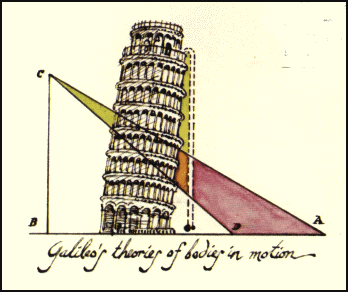
It was a physics question that got the point across to me. One of those SAT/GRE questions that seems so easy on the surface, but which, even when I got them right, never felt right:

Two objects of the same size and shape, but one of which is twice as heavy as the other, are dropped from a roof at the same time.  Which lands first?

I was driving home listening to National Public Radio. The host was interviewing experts in “physics education research.” Not something I normally would have found scintillating, but with the only alternative endless minutes of “drive time” advertising, I listened in.

Ergo, the question.

And the answer: they land at the same time.

You think I’m kidding, don’t you? If something is twice as heavy as something else, shouldn’t it fall faster? Twice as fast? Won’t it at least hit first?

Uh… well…no.

I knew the right answer, but had no understanding of why it was right. Clearly, my physics education left something to be desired. I couldn’t seem to grasp a basic concept of Newtonian physics.

It turns out that I’m not alone. It seems that something like 75% of Harvard University students who had taken Harvard’s basic physics class also had trouble with this question, even after they’d taken the course and knew the right answer!

For good reason. It contradicts some commonsense, deeply felt, intuitive notions about how the physical world works. In fact, according to the experts, the reason most students leave physics courses with little conceptual grasp of physics is that many, if not most, of our commonsense notions about how the world works are incompatible with Newtonian physics.

In other words, much of physics is counter-intuitive, and so even when we know the right answer, our commonsense, intuitive “fall back” positions on what is going to happen around us are just plain wrong.  But we keep on responding as if they were right anyway. We keep on waiting for that heavier object to land first.

What does this have to do with “Strategic Leadership Communication?” Simple. If the last twenty years of research in social psychology, communication, behavioral economics, and cognitive neuroscience have demonstrated anything, it’s that what’s true of our commonsense, intuitive understanding of how things work in the physical world turns out to be equally true of our intuitive, commonsense understanding of how things work in the social world: far too often, they’re just plain wrong.

Ergo, the raison d’etre of this blog: at least as far as strategic communications goes, to help leaders get it right.

Posted in Communication and Cognition, Counter Intuition and Communication | Tagged , , | 2 Comments

Power and Persuasion: A CEO Responds

My last entry, “Power and Persuasion: Friends or Foes? (Part 2),” cited evidence that the “subjective experience of power” tended to result in what researcher Leigh Plunkett Tost of Duke University called the “power-induced neglect of the judgments of others.”[1]

A CEO of a small, well-capitalized energy company who reads this blog, dashed off a smart, passionate response that I think is worth sharing in full:

 [I] agree power is possibly corrupting [the] full exchange of ideas.  But you don’t give any credit to what “earned” that power, i.e., competence, capital risked, the need for speed in some decision environments, or a “buck stops here” accountability that some of the “Group” may not share or want.  Power is positional for a reason.

Not all leaders or situations have the luxury of time to go seek out ideas from everyone [or] to “persuade” them to buy-in to your ideas or direction.  But I agree with the general premise that more buy-in to the plan promotes a well-led constituency. 

Just remember that those who have paid the price for power are sometimes justified to use it.  Abuse of power is a different subject.

A couple of comments:

First, there are obviously situations when speed and decisiveness are the essence of leadership, precluding the inevitably lengthy exercise of influence and persuasion. A healthy reminder that situations can make the leader as much as the leader makes situations.

Second, while power certainly comes with perks, it also comes with burdens, not the least of which is the burden of accountability. But if I read the research right, an additional burden of power is what we might call “psychological inflation”: the boost in confidence and competitiveness that comes with getting to the top. The downside of this “psychological inflation” for leaders is that it tends to make it easier for them to undervalue the opinion of others.

Perhaps the most effective leaders, and I would place this particular CEO in that category, are those who can acknowledge the “inflationary” push on their valuation of their own opinion, but don’t give in to it.


[1] Power, Competitiveness, and Advice Taking: Why the Powerful Don’t Listen,” Leigh Plunkett Tost, Duke University, lead author, soon to be published in the journal, Organizational Behavior and Human Decision Processes

Posted in Communication and Power, Persuasion and Influence | Tagged , , , , | Leave a comment

Power and Persuasion: Friends or Foes? (Part 2)

Is there some way that having power undermines one’s willingness to use persuasion to engage employees? That is the question.

The answer is “No!”…. If you think persuasion means strong-arming someone into compliance by the strength of your arguments or the power of your position.

Of course, if you think that, you see persuasion, whether wittingly or unwittingly, as simply the verbal exercise of power. So it begs the question.

Without diving into a definitional swamp[1], what’s relevant to know about persuasion for our purposes is that, insofar as it is effective, it is a “learning and negotiating process” that involves “discovery, preparation, and dialogue,” that can take “weeks or months of planning” before you can “lead colleagues to a problem’s shared solution.”[2] In other words, effective persuasion is a relationship that requires and rewards a deep investment in listening.

 So what does this all have to do with power?  Simple: the powerful don’t listen!  Actually, it’s even more subversive than that: “not only does the experience of power lead individuals to be less open to using advice from others, but… power can lead individuals to discount advice even from individuals who have high levels of expertise.”[3]

 The key words here are “experience of power.” According to Leigh Plunkett Tost, of Duke University’s Fuqua School of Business, who graciously shared her research findings with me, the subjective experience of power has psychological effects that work against the need to persuade others.

What is it about power that undermines an orientation toward using persuasion? Tost’s and others research suggest that a subjective experience of power:

  • Produces a sense of optimism, diminishing the perception of high risk.
  • Creates an inflated sense of control, generating overconfidence in one’s capabilities.
  • Heightens one’s sense of the superiority of one’s own opinions and perspectives, undermining the desire to depend on the insights of others.
  • Enhances a sense of competitiveness, creating a desire to demonstrate superior knowledge in the face of unsolicited advice, even from experienced counselors with high expertise.

The result is what Tost calls the “paradox of power”: “greater decision rights are often coupled with a power-induced neglect of the judgments of others.”

In other words, there is something about power that undermines a leader’s desire to engage others’ input and opinions, and therefore to feel a need to exercise persuasion and influence.

This is not good news. In fact, it’s quite sobering for those of use who counsel senior leaders, because it adds a subtle, complicating psychological factor to what is already a difficult, complex job.

But it’s not all bad, either, because this research provides concrete, data-backed insight into what had simply been an intuition based on experience.  As Ronald Reagan might put it, “Trust your intuition, but verify.” Now we have important verification.

Good, as well, in that it provides a nice explanatory and analytical framework to understand leadership behavior that can often seem self-defeating.

What’s ugly about this, or at least makes a complicated situation more complicated, is that the research expands awareness, yet doesn’t provide any easy answers. As a senior leader, how can you manage your way through the “power paradox”? How do you transcend the allure that comes with the “subjective experience of power,” and ensure you rely on persuasion and influence to incorporate the wisdom and engage your employees?

More weighty questions. I’ll save those for my next vacation.


[1] Trying to define and describe persuasion and what makes it effective is a sinkhole: it can easily take two semesters of study just to keep your feet firmly planted on the ground.  If you’re inclined to self-school on the subject, consider starting with: (1) James B. Stiff, Persuasive Communication; or (2) Jim Dillard’s Persuasion Handbook.

[2] Though it is somewhat simplifying, a very smart and practical look at what makes for effective persuasion comes from “The Necessary Art of Persuasion,” a classic HBR article by Jay Conger, the Henry R. Kravis Research Chair in Leadership Studies at Claremont McKenna College.

[3] “Power, Competitiveness, and Advice Taking: Why the Powerful Don’t Listen,” Leigh Plunkett Tost, Duke University, lead author, soon to be published in the journal, Organizational Behavior and Human Decision Processes.

Posted in Communication and Cognition, Communication and Power, Persuasion and Influence | Tagged , , , , , , | 2 Comments

Power and Persuasion: Friends or Foes? (Part 1)

When you’re on vacation the idea is to not think about business, to not let the “itch” of issues get under your skin.  In that sense, my time off this summer was…. well, let’s call it a semi-success.

Part of the problem was the responses to my last extended blog entry, “The Department of Redundancy Department.” The blog had made some inferences about strategic leadership communication based on recently published research which found that project managers with “positional power” were less likely to use persuasion to get things done than those without it.

The responses tended to fall into one of two camps.  One basically accused me of being oblivious to the obvious: “real” leaders, they dismissively pointed out, use persuasion and influence.  Ergo, in the research, those managers with “positional power” who didn’t use persuasion weren’t “real” leaders.  Really, Barry, they seemed to be saying, do we really have to point this out to you? I could almost sense the schadenfreude, the secret pleasure that a “smarty pants” blogger who thinks he’s cool because he quotes Harvard research had missed the most self-evident, basic truth about leadership.

I responded politely, and didn’t bother to point out that their argument was, in fact, an almost perfect example of circular reasoning–circulus in probando—which while full of sound and fury, signified nothing.

Much smarter, and more informed, were the responses from research-savvy communication practitioners who pointed out that: (1) the sample size of the Harvard research was small, and the results, therefore, not easily generalizable; and (2) it focused on project managers, not senior leaders, and therefore didn’t directly support the inferences I had made.

All true. And yet, curiously enough, none of the respondents who pointed out the error of my ways was willing to take the next step and say that my inferences were false. As seasoned professionals, they had worked with lots of senior leaders, and had enough experience to sense, just as I did, that something about being in power makes one less likely to engage people using persuasion and influence.

Wondering what that might be was an “itch” that kept pulling at me during my vacation, breaking through my efforts to relax and pull away.  I had suggested several justifications leaders might have for not using persuasion, but justifications aren’t reasons. And I wasn’t ready to shrug my shoulders, and accept the finding as a fait accompli, yet another proof of Lord Acton’s tried and true, if trite adage: “All power tends to corrupt, and absolute power corrupts absolutely.”

That only generated to more questions: why does power corrupt? Or better yet, how? What is it about power that is corrupting? What are the social, organizational, or psychological dynamics that tend to pull even the best-intentioned leaders away from using persuasion and influence and toward the exertion of authority?

Truthfully, I had no good answers. But awaiting me upon my return from vacation was a soon-to-be-published research article that offered insights into exactly these questions.  I’ll share those insights in the next entry of “Power and Persuasion: Friends or Foes?”

Posted in Communication and Power, Persuasion and Influence | Tagged , , , , | Leave a comment

The Department of Redundancy Department (4) What is to be done? Or the medium is the message.

What to do when the case for persistent, redundant communications is compelling, but senior executives are not easily compelled?

As we’ve suggested in an earlier blog, part of the resistance to redundancy is situational: Something about “positional power” makes redundant communications seem unnecessary.  And for those senior leaders who, by personal preference, want to shirk sticking to the same theme anyway? There is an abundance of rationales from which to choose, including:

  • It takes too much time
  • Most of their people do what they’re asked without it
  • It’s just too darn tiring, exhausting, mentally fatiguing

What is the professional communicator to do? As a start, they should do their best to marshal the evidence for redundant communications, and make the most compelling, persuasive case they can.  With some leaders, it will work.  But then, again, with some leaders it won’t.

The original research behind this muli-part blog suggests, at a minimum, a mitigating strategy for managing senior leaders who are reluctant to go over the same message more than once:

Ensure they do the message at least once, but using personal media, like face-to-face or phone first!

Once the message is out there, communicators can then:

Reinforce it multiple times with less personal media, like an email reminders, newsletters, portal posts, etc.[1]

Okay. I know this is standard practice for most professional communicators worth their salt. So the advice may seem a bit anti-climatic.  But that doesn’t make it any less necessary.  It’s something communicators have to do, even if it requires a somewhat Faustian bargain with recalcitrant senior leaders to ensure it happens:

Do it once in person, and I’ll take care of the rest.”

It is the “in person” that counts, combined with the need for it to come first. According to the research that jump-started this series, one of the differentiators between project managers who proactively engaged in redundant communication and those who were reactive – communicating again only when the initial communication didn’t produce the desired results – was the order in which they used media.

Those project managers who relied on influence and persuasion to achieve desired results communicated first using what I’ve called “personal” media, or what academics refer to as “rich” media – media that allows the communicator to pick up the nuances of the response to their communication, whether because they were face-to-face, or because they could hear variations in voice (by phone).

When you can instantaneously gauge the emotional response to a communication, it allows you to quickly recalibrate the message or its delivery, or to at least provide an immediate explanation of the underlying “why”[2] behind those portions of the message that led to the emotional response.

Needless to say, project managers with “positional authority” tended to do the opposite: use impersonal or “lean” media, like emails, or spreadsheets, first. And then, and only then, when the initial message didn’t produce the desired result, they switched to more personal media.

It’s fairly easy to imagine: They send an email requesting an action. When nothing happens, they get on the phone. Totally reactive.

Ergo, the obvious remedy: reverse the order.  “Rich” or personal media first: speak in person or by phone or videoconference; “lean” or less personal media second: emails, newsletters, etc.

That one step won’t save the day, but it might lessen the need for the day to be saved.

****

That’s it. So it ends – my multi-part blog on redundant communications – admittedly not with a bang, but with more of a whimper. But it’s with a whimper that works. Professional communicators already know this. Senior leaders still have room to learn.


[1] In the age of globalization and geographically dispersed virtual teams, the power and importance of face-to-face communications is the subject of much debate, as this recent Economist story on when it’s necessary to travel suggests.  Also see my blog, “It’s not what you say. It’s how you look!” on the apparent, but subtle distortions of videoconferencing, “the next best thing  to being there”.

[2] See my blog series, “Why ask why?”

Posted in Uncategorized | 1 Comment

The Department of Redundancy Department (3) Why leaders need to say the same thing over and over again; and why they don’t

A number of years ago, I worked for the chairman of a multi-billion dollar global enterprise with very well known brands. He was (and presumably still is) a superb, inspirational communicator who wanted to make sure that his senior leaders and mid-level managers around the globe heard his strategic message directly from him. He understood that, when it comes to getting people to support a strategy, face-to-face communication is more powerful, more persuasive and more personal than any other media.

So, to his great credit, he made the investment of time and energy, and took himself on the road to communicate directly to his employees. He traveled globally, meeting with hundreds of influential managers, personally delivering his key strategic messages. We estimated that during one three-month period, he must have delivered his message at least 60 times. And effectively every time. No communicator could ask for more.

Well…. except me, perhaps. The problem was that while he had communicated his strategy 60 times, and maybe even in 60 different ways, he had done so to 60 different audiences.  While he had heard his messages 60 times, everyone else had heard it only once. Naturally, he was sick of it! And understandably so.

Upon his return to the U.S., I was asked to set up a “town hall” meeting for him at the division where I worked. In discussing his presentation, I urged him to reprise the strategic message he had presented on his last visit. I pointed out that if employees were to remember it, it had to be reinforced, and nothing was more powerful than hearing it from him in person. Again.

Conceptually, he understood. But emotionally, he couldn’t do it anymore. He had delivered the damn thing so many times, in so many places, to so many people, in so many ways, the thought of doing it even one more time was more than he could bear. He simply wanted to, had to, say something new.  Yet, to my audience, which had heard him only once, the old message was new.

It was a near impossible argument to win. And I didn’t. Of course, had I known then what I know now, I wouldn’t have been as insistent as I was.  I hadn’t yet learned a secret that most communication practitioners who work with senior leaders know, and which senior leaders, if they don’t know, find out soon enough:

Saying the same thing over and over again, even if not in the same way, is tiresome, boring, and frustrating!

This is true, of course, for everyone, but it is especially true for the most senior of leaders. Their work is dynamic, constantly changing and largely without repetitive tasks. They are unused to the particular mental fatigue associated with redundancy – in anything, much less communications. And they’re not easily incented to communicate redundantly given that:

 The impact of doing so on business outcomes is neither clear nor immediate, and not easy to measure anyway!

Message fatigue for leaders of large, geographically dispersed organizations is a common, rarely discussed issue that undermines a lot of communication campaigns. True even for those leaders who are already models of strategic leadership communication (maybe especially for those leaders, because they’re more likely to engage in redundant communication.)

So, what is to be done? And not just to eliminate the boredom associated with redundant communications, but to change those entrenched executive mindsets that rationalize their way to avoiding them?

On a general level…. not much. The complex reality is that there is no easy, “one size fits all” answer.  Some leaders can be persuaded to change their mental models regarding redundant communications.  And some cannot. It’s a “one-leader-at-a-time” process that, at its worst, can feel like psychological trench warfare. And even with exemplary leaders, who are already committed to redundant communications, there will be losing battles.  I know.

In the meanwhile, however, all is not lost. An alternative approach to ensuring redundant communications is to focus less on a leader’s mindset, and more on their use of media.  We’ll discuss that approach in the fourth, and final entry of “The Department of Redundancy Department.”

Posted in Uncategorized | Tagged , , , , , | Leave a comment