
It was a physics question that got the point across to me. One of those SAT/GRE questions that seems so easy on the surface, but which, even when I got them right, never felt right:
Two objects of the same size and shape, but one of which is twice as heavy as the other, are dropped from a roof at the same time. Which lands first?
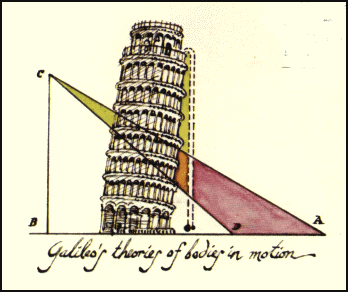
I was driving home listening to National Public Radio. The host was interviewing experts in “physics education research.” Not something I normally would have found scintillating, but with the only alternative endless minutes of “drive time” advertising, I listened in.
Ergo, the question.
And the answer: they land at the same time.
You think I’m kidding, don’t you? If something is twice as heavy as something else, shouldn’t it fall faster? Twice as fast? Won’t it at least hit first?
Uh… well…no.
I knew the right answer, but had no understanding of why it was right. Clearly, my physics education left something to be desired. I couldn’t seem to grasp a basic concept of Newtonian physics.
It turns out that I’m not alone. It seems that something like 75% of Harvard University students who had taken Harvard’s basic physics class also had trouble with this question, even after they’d taken the course and knew the right answer!
For good reason. It contradicts some commonsense, deeply felt, intuitive notions about how the physical world works. In fact, according to the experts, the reason most students leave physics courses with little conceptual grasp of physics is that many, if not most, of our commonsense notions about how the world works are incompatible with Newtonian physics.
In other words, much of physics is counter-intuitive, and so even when we know the right answer, our commonsense, intuitive “fall back” positions on what is going to happen around us are just plain wrong. But we keep on responding as if they were right anyway. We keep on waiting for that heavier object to land first.
What does this have to do with “Strategic Leadership Communication?” Simple. If the last twenty years of research in social psychology, communication, behavioral economics, and cognitive neuroscience have demonstrated anything, it’s that what’s true of our commonsense, intuitive understanding of how things work in the physical world turns out to be equally true of our intuitive, commonsense understanding of how things work in the social world: far too often, they’re just plain wrong.
Ergo, the raison d’etre of this blog: at least as far as strategic communications goes, to help leaders get it right.


 Strategic Leadership Communication
Spot on!
Mike Kleinb
Thanks, Mike. Glad you’re reading it!